
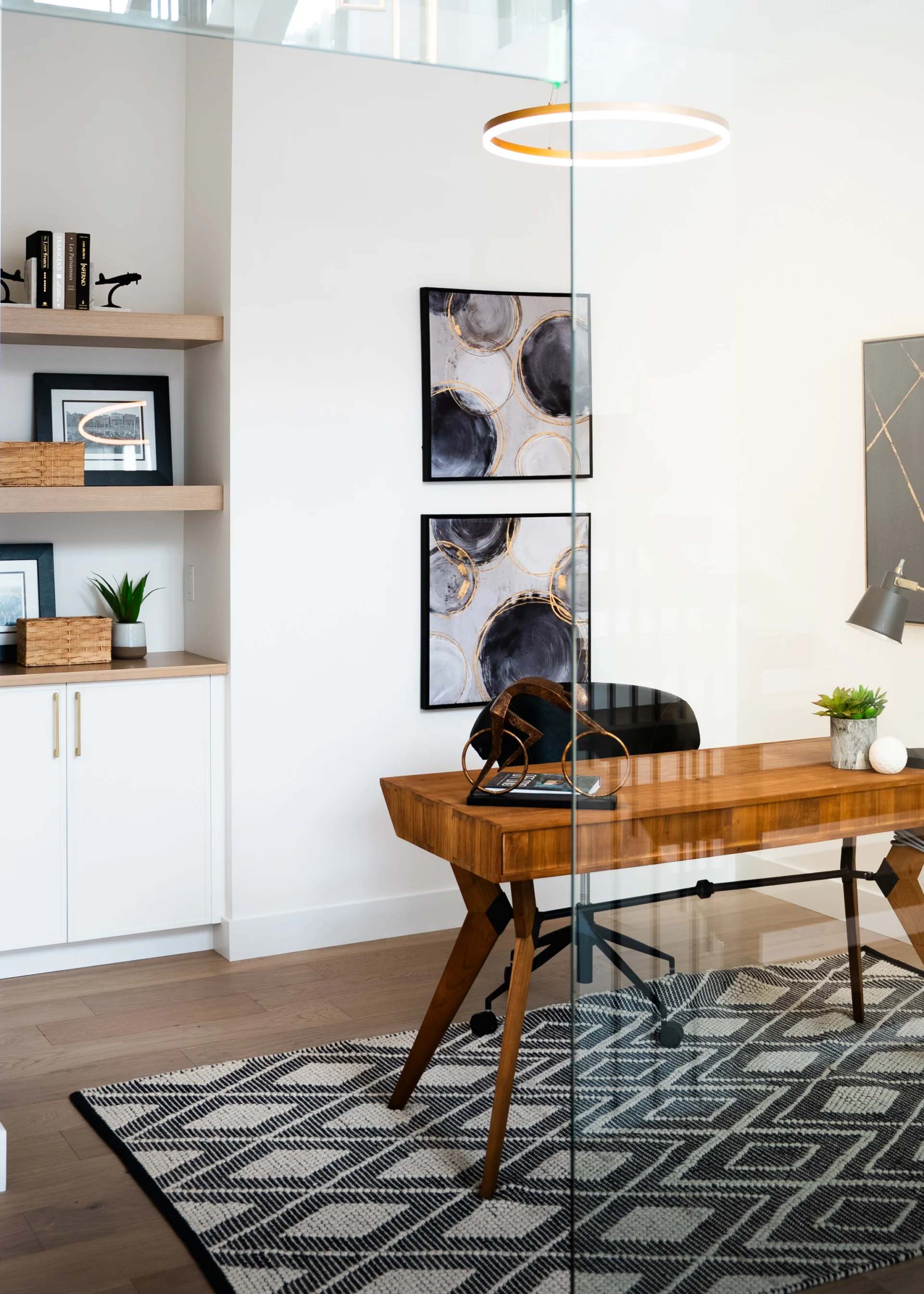

The corner desk in the basement was never built for a CEO’s schedule. Yet for years, that’s exactly where executives, founders, and senior professionals ran board calls, closed deals, and made decisions that moved entire organizations. That era is over. Among Edmonton’s top-tier buyers, the home office has moved from afterthought to architectural priority, and the reasons behind that shift say a lot about how high performers now think about where, and how, they work.
The Office Is No Longer A Room. It’s An Asset.
For business owners and executives, a home isn’t just where life happens after hours. It’s part of the operating environment. A well-designed office contributes directly to focus, to the quality of a video call with investors, to the tone set for a client dropping by, and to how effectively the day actually gets managed. Buyers in this category aren’t looking for a spare bedroom with a desk pushed against the wall. They’re looking for a room engineered for performance: strong natural light, real acoustic separation, and a door that closes when the stakes are high.
That’s no longer a preference. It’s due diligence on the property itself. Just as a business leader wouldn’t accept a headquarters with poor infrastructure, today’s top buyers won’t accept a home that undermines their ability to perform. The office has become a proxy for how seriously the rest of the property was designed.
Why This Shift Happened Now
Three forces converged to push the home office up the priority list. First, hybrid and remote leadership became permanent for a meaningful share of executives, not a pandemic-era exception. Second, the line between “work happens at the office” and “work happens wherever I am” has effectively disappeared for anyone running a company or managing a portfolio. Third, high performers have simply become more deliberate about the environments that shape their output, applying the same scrutiny to their home that they apply to their business operations.
Put together, these forces mean the office is no longer competing with a formal dining room or a rarely used den for space on the floor plan. It’s competing with, and often winning against, rooms that once seemed far more essential.
Built For Range, Not Just Remote Work
The busiest professionals rarely use their office for one thing. The same room might host a morning of investor calls, an afternoon of deep work on a strategic plan, and an evening spent helping a child with homework or reviewing a personal project. That kind of range doesn’t happen by accident. It’s the result of a few deliberate design decisions:
- Natural light calibrated to perform for a 7 a.m. call and a late-evening session equally well
- A door and layout that guarantee privacy regardless of what else is happening in the home
- Custom storage and millwork that let the room reset cleanly between roles
- Wiring and connectivity built in from the start, rather than patched in after the fact
- Acoustic considerations that keep a boardroom-quality call from competing with the rest of the household
Get those details right, and the office becomes one of the hardest-working rooms in the house, capable of carrying the full weight of a demanding professional’s day without feeling like a compromise in any direction.
The Psychology Of A Well-Designed Workspace
There’s a reason this matters beyond aesthetics. Environment shapes performance. A room with poor light, no privacy, and constant interruption chips away at focus in ways that are easy to underestimate and hard to reverse over a long day. Executives who spend real hours in their home office notice the difference almost immediately: sharper focus during deep work, more composure on high-stakes calls, and a cleaner mental separation between “on” and “off” when the door closes at the end of the day.
That separation matters more than it might seem. For entrepreneurs and senior leaders whose work rarely stays contained to a nine-to-five, a well-defined office gives the rest of the home permission to stay a home. Without that boundary, work has a way of bleeding into every room, and eventually, into every hour.
Designed To Scale With The Career
The most strategic buyers aren’t just evaluating what a room does now. They’re thinking several years ahead, the way they would any other investment. Roles change. Companies get sold or scaled. Priorities shift. A property that can’t adapt to that trajectory starts to feel like a liability rather than an asset.
A well-planned layout treats the office as genuinely convertible: an executive workspace today, a private suite, guest quarters, or a secondary bedroom tomorrow. That kind of built-in optionality, designed in from the start rather than retrofitted later, is precisely what separates a good property from one built for how successful people actually live and work. It also protects resale value. A rigid, single-purpose room limits a property’s appeal to the next buyer. A flexible one expands it.
What This Means For Buyers And Sellers
For buyers in this category, the takeaway is straightforward: treat the home office with the same scrutiny applied to any other high-value decision. Look past the paint and the furniture staged for a showing, and ask whether the room’s light, layout, and privacy would actually hold up to a real workday.
For sellers and those preparing a property for market, the message is just as clear. A home office that reads as an intentional, well-executed space, rather than a converted spare room, signals to sophisticated buyers that the rest of the property was built with the same level of care. In a market where discerning buyers are comparing properties on more than square footage, that signal can be the difference between a listing that lingers and one that moves.
The Bottom Line
For today’s executives and entrepreneurs, a home office isn’t a bonus room. It’s infrastructure. It reflects how seriously a property was designed to support real performance, real privacy, and real flexibility as a career evolves. Light, privacy, and forward-thinking design are what make that possible, and they’re exactly the details that separate a house from a home built for someone running at the top of their game.

